Morpheus X2
70-90GHz
High-performance E-Band transceiver with linear Tx output power 24dBm
Our next generation Morpheus X2 E-Band transceiver module pushes the boundaries of performance even further, supporting linear Tx output power in excess of 24dBm. E band represents the frequency range from 60 GHz to 90 GHz. Dell’Oro Group has forecast that E-band mmWave radio links will experience the fastest growth of all the frequency bands over the five-year period to 2026, with the combined E-band and V-Band market predicted to grow at a compound annual growth rate (CAGR) of 25%. This growth is being driven by the global demand for XHaul for 5G networks, for which radio links in the mmWave bands can provide both high capacity and high data rate. Filtronic’s device-agnostic Microwave and mmWave transceivers, offer high-performance, are competitively priced and significantly reduce client time to market.
Get a quotation
Please complete the form below and we will be in touch to discuss you quotation
Designed for:
-
Datasheet
-
Get a demo
Get a demo
Please complete the form below and we will be in touch with more information about a demo.
-
Request a sample
Request a sample
Please complete the form below and include details of the model and specification you would like a sample of, and we will be in touch about the next steps.
Overview
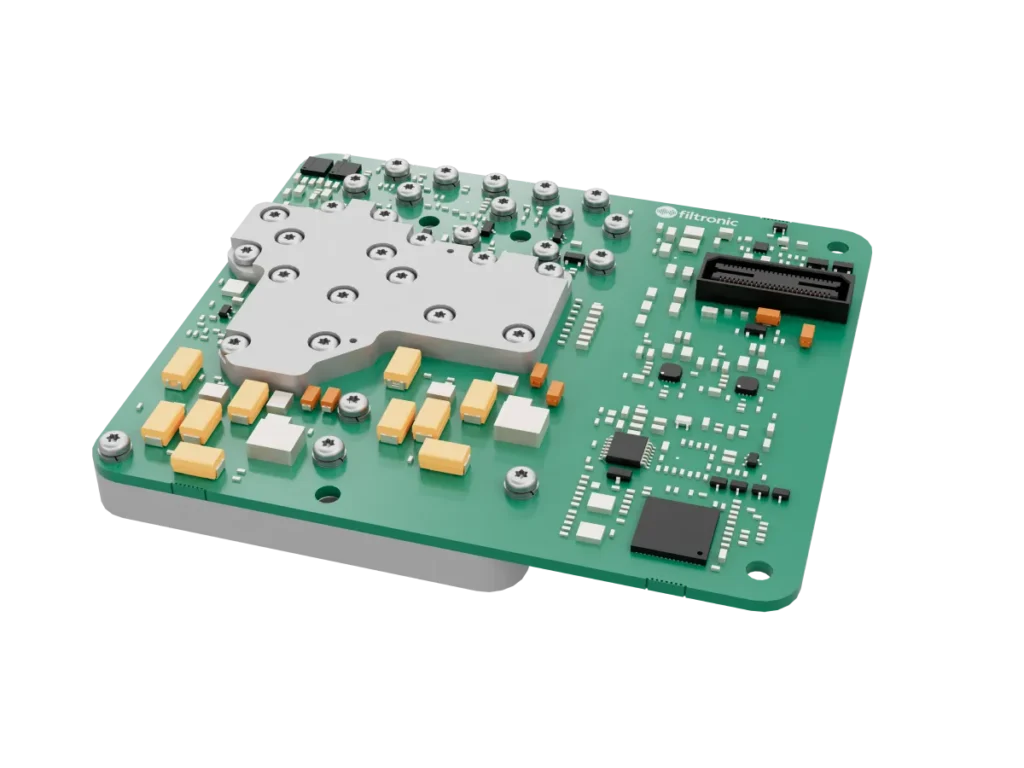
Morpheus X2 is an advanced E-Band transceiver module engineered for carrier-grade applications in 5G backhaul, midhaul, and fronthaul – collectively known as XHaul. Operating in the 71–76 GHz (Tx) and 81–86 GHz (Rx) frequency bands, this module integrates all necessary RF transmit and receive functions required for high-capacity E-Band radio links. Notably, the Morpheus X2 delivers a linear transmit power output of +24 dBm, which is 3 dB higher than its predecessor, the Morpheus II, while maintaining a compact footprint of 90 x 80 mm. This enhancement enables longer link distances and improved performance in demanding mmWave XHaul applications.
Designed with versatility in mind, the Morpheus X2 supports channel bandwidths exceeding 2 GHz and accommodates modulation schemes up to 512QAM, optimising spectral efficiency for high data throughput. The module features low phase noise VCOs, settable via an SPI interface in 31.25 MHz steps, to support ECC/ITU channel arrangements. Its integrated diplexer connects directly to an antenna via a standard WR12 interface, simplifying installation and reducing system complexity. With a receiver noise figure typically ranging from 7 to 8 dB – and an enhanced option achieving between 4.5 and 5.5 dB for specialized applications – the Morpheus X2 ensures superior signal clarity, making it an ideal solution for high-capacity payloads in Low Earth Orbit (LEO) satellite constellations and High-Altitude Platform Systems (HAPS).
Why choose Morpheus X2?
- High power and extended range – Delivers +24 dBm linear transmit power, 3 dB higher than its predecessor, enabling longer link distances and enhanced performance in 5G XHaul and satellite applications.
- Advanced modulation and spectral efficiency – Supports modulation schemes up to 512QAM and channel bandwidths exceeding 2 GHz, maximising data throughput and optimizing spectral efficiency.
- Seamless integration and low latency – Features low phase noise VCOs, an integrated diplexer with WR12 interface, and SPI-controlled frequency settings, ensuring precise, reliable operation in high-capacity communication networks.
Morpheus X2 is a cutting-edge E-Band transceiver module, designed for high-capacity wireless links in 5G backhaul, LEO satellites, and HAPS networks. With enhanced power, superior spectral efficiency, and seamless integration capabilities, it provides a future-proof solution for next-generation telecommunications infrastructure.
Morpheus X2 highlights
Good to know
Delivers +24 dBm linear output, providing extended range and improved link performance.
Supports modulation up to 512QAM and channel bandwidths exceeding 2 GHz for maximum data throughput.

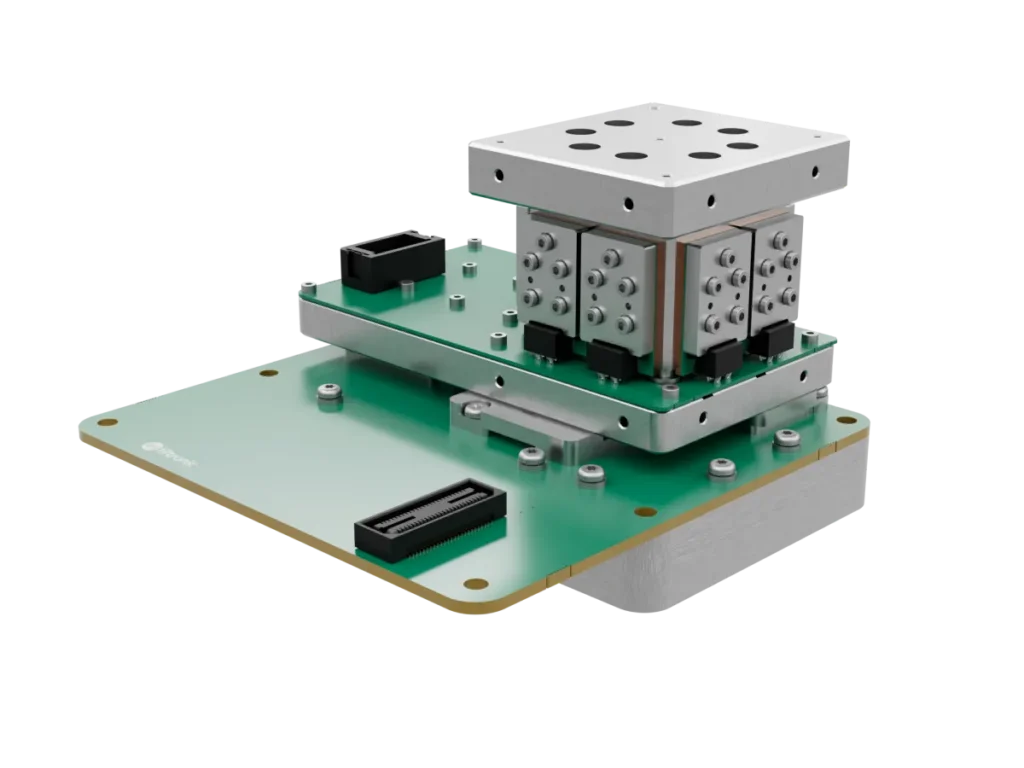
Equipped with an integrated diplexer and WR12 waveguide interface, simplifying installation and system design.
With a rugged form factor (90 x 80 mm) and an optimised receiver noise figure, it is ideal for 5G XHaul, LEO satellites, and HAPS applications.
Performance
High transmit power
Wide bandwidth support
Wide frequency coverage:
Operates in 71-76 GHz (Tx) and 81-86 GHz (Rx) bands, making it ideal for 5G XHaul and satellite applications.
Superior spectral efficiency:
Supports modulation up to 512QAM and >2 GHz channel bandwidth, optimising high-speed data transfer.
Low phase noise and high stability :
Features -112 dBc/Hz phase noise at 1 MHz offset, ensuring stable and precise frequency performance.
Compact and easy integration:
Includes an integrated diplexer, single T/R port, and WR12 waveguide interface, simplifying system deployment.
Performance key data
| Parameter | Value |
| Transmit frequency | 71-76 GHz (TA446) / 81-86 GHz (TA447) |
| Receive frequency | 81-86 GHz (TA446) / 71-76 GHz (TA447) |
| Max transmit power | >24 dBm (Linear), PSAT: 30 dBm |
| Modulation support | Up to 512QAM |
| Noise figure (Rx) | 7-10 dB (high gain mode) |
| Phase noise (@ 1 MHz) | -112 dBc/Hz |
| Output IP3 @ 24 dBm | 36-37 dBm |
| LO frequency step | 31.25 MHz |
| Operating temperature | -33°C to +75°C |
MORPHEUS X2 FAQ’s
General questions
Q: What is the Morpheus X2?
A: Morpheus X2 is an advanced E-Band transceiver module designed for high-capacity 5G XHaul, Low Earth Orbit (LEO) satellites, and High-Altitude Pseudo Satellites (HAPS) applications. It operates in the 71-76 GHz (Tx) and 81-86 GHz (Rx) bands, providing reliable, high-speed wireless connectivity.
Q: What makes Morpheus X2 different from its predecessor?
A: Morpheus X2 delivers +24 dBm linear transmit power, which is 3 dB higher than the Morpheus II, enabling longer-range connectivity and improved link performance. It also features low phase noise and high spectral efficiency, making it ideal for next-generation telecommunications infrastructure.
Performance and features
Q: What is the maximum transmit power of Morpheus X2?
A: The module provides a +24 dBm linear output, ensuring strong, long-range signal transmission in high-capacity networks.
Q: What modulation schemes does it support?
A: Morpheus X2 supports modulation up to 512QAM, optimising spectral efficiency and data throughput.
Q: How much bandwidth does Morpheus X2 support?
A: It supports channel bandwidths exceeding 2 GHz, enabling high-speed, low-latency communication.
Q: What is the receiver noise figure?
A: The receiver noise figure typically ranges from 7 to 8 dB, with an enhanced option achieving between 4.5 and 5.5 dB for specialised applications.
Integration and compatability
Q: Can Morpheus X2 be integrated into existing network infrastructure?
A: Yes, it features an integrated diplexer and a WR12 waveguide interface, making integration simple and efficient for 5G backhaul, satellite, and aerospace applications.
Q: Does Morpheus X2 support frequency tuning?
A: Yes, it includes low phase noise VCOs that are settable in 31.25 MHz steps via an SPI interface, ensuring precise frequency control.
Q: What are the size and weight specifications of Morpheus X2?
A: The module has a compact footprint of 90 x 80 mm, making it ideal for space-constrained applications.
Reliability and compliance
Q: What is the expected operational lifespan of the Morpheus X2?
A: Morpheus X2 is built for long-term reliability, utilising Filtronic’s field-proven millimetre-wave technology to ensure high durability.
Q: What environmental conditions can it withstand?
A: The Morpheus X2 is designed to operate in extreme environments, making it suitable for LEO satellites, high-altitude platforms, and ground-based telecom networks.
Support and warranty
Q: Does Morpheus X2 come with a warranty?
A: Yes, Filtronic provides a standard warranty. Please contact Filtronic for specific terms.
Q: Where can I purchase Morpheus X2?
A: You can contact our team here for purchasing inquiries.
Q: Does Filtronic provide technical support for integration?
A: Yes, technical support and documentation are available to assist with integration and field deployment.