Filtronic develops advanced RF filters for quantum computing
Addressing specific challenges associated with operating at extremely high frequencies and cryogenic environments
Despite quantum computing’s origins in the 1980s, the technology has evolved faster than its supply chain in recent years. In quantum computers, microwave technology can play a key role. Microwave circuits can be used to both excite and read back the quantum states within the quantum computer’s processor.
At Filtronic, we excel in tackling complex RF, microwave, and mmWave challenges, delivering innovative solutions for demanding applications, including quantum computing. Our award-winning UK design and manufacturing facilities enable us to design (300MHz to 300GHz), manufacture (300MHz to 115GHz), and test (300MHz to 140GHz) RF components and subsystems. As leaders in filters, diplexers, and low-noise amplifiers, we offer significant expertise to the quantum computing sector.
As a premier RF design and manufacturing company, we provide quantum computing manufacturers with the following benefits:
- Accelerated market entry by reducing development and design time for RF components and subsystems.
- Lower development and lifecycle costs for complex projects.
- Risk mitigation by minimizing quality and delivery costs.
- Delivering high-quality, reliable solutions tailored to the unique needs of the quantum computing field.
RF components can be integrated with existing quantum computing platforms, facilitating the development of more compact and efficient quantum processors.
Ask an expert
Filtronic creates products, that help shape the future
Over 45 years of innovation in RF filters for complex applications:

Low noise amplifiers
In-house MMIC engineers and proven LNA expertise ensure high-performance solutions.

Diplexers
Proven expertise in customised diplexer and multiplexer solutions for quantum computing.

Filters
Radio frequency testing and 5G wireless network measurement

Hybrid manufacturing services
Precision hybrid manufacturing facilities including mmWave characterisation.
Who we help

Quantum computing manufacturers
Customised filter solutions
How we help

Adaptive filtering
Our switched filter banks are helping Quantum manufacturers to adjust radio frequency parameters dynamically, mitigating interference, enhancing signal reception, and optimising performance in varying environments including cryogenic.

Cryogenic temperatures
Experts in complex mmWave adaptive filtering at cryogenic temperatures. Operating in cryogenic environments necessitates a unique approach to material selection due to fundamental changes in material properties at superconducting temperatures.
Benefits

Agility
We have an agile culture, fostering adaptability, innovation, and rapid response to changes, enabling our customers to outmanoeuvre their competitors and seize opportunities effectively.

SWAP-C
System integration experts, minimising size and weight and improving performance.

High performance
Our signature offerings include Switched Filter Banks, which can be seamlessly integrated into single modules, facilitating intricate switching and filtering operations within a compact footprint.

Customisation
We offer a range of customised solutions including, the custom design of RF modules, leveraging our proven track record across complex applications.

Speed to market
Our diverse array of filter technologies, including waveguide-based solutions, serve as proven building blocks, expediting the development cycle for our clients.
RF products for high-performance adjacent markets
- Filtronic’s role in Quantum Computing
- About RF Filters in Quantum Computing
- Filter types and applications
Filtronic’s role in Quantum Computing
At Filtronic, we excel in tackling intricate RF, microwave, and mmWave hurdles head-on. Our forte lies in creating innovative solutions for even the most demanding applications, with Quantum Computing being no exception. With a rich history of delivering cutting-edge solutions, our UK-based design and manufacturing facilities stand as testaments to our commitment to excellence. Specialising in filters, diplexers, and low-noise amplifiers, we bring unparalleled proficiency to the table.
Filtronic’s RF filters play a critical role in advancing Quantum Computing by addressing specific challenges associated with operating at extremely high frequencies and cryogenic environments. These filters are tailored for quantum computing systems that rely on superconducting qubits and offer the following benefits:
- Minimising noise
Quantum computers are highly sensitive to microwave noise, especially in the millimeter-wave (mmWave) spectrum. Filtronic’s filters provide excellent out-of-band rejection at these frequencies, reducing noise that can disrupt qubit coherence and overall system performance. - Cryogenic suitability
Quantum computers often operate at temperatures near absolute zero. Filtronic develops its filters with materials that maintain optimal performance under such extreme conditions, addressing changes in material properties at cryogenic temperatures. - Compact and flexible design
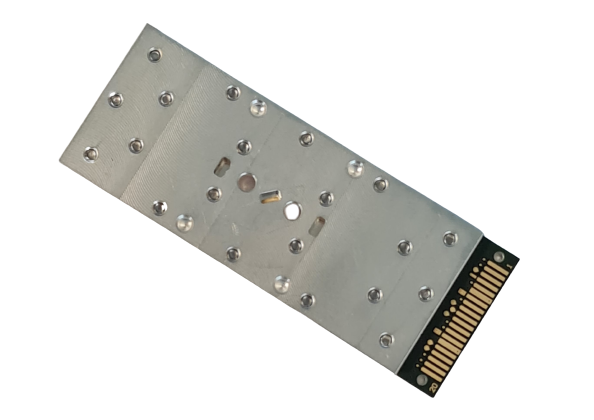
The filters are engineered to be compact, with stacked waveguide channels that allow flexibility and efficient use of space in the tightly packed environments of quantum processors and their external control racks. - Custom solutions
Filtronic designs bespoke RF solutions, such as microwave filters and diplexers, for quantum computing companies. These components support both the control systems outside the dilution refrigerator and the circuits inside, ensuring precision and reliability.
These advancements make Filtronic a valuable partner for quantum computing manufacturers, enhancing the scalability and feasibility of quantum systems.

About RF Filters in Quantum Computing
In quantum computing, RF (radio frequency) filters play a crucial role in ensuring the accurate control and measurement of quantum systems, particularly in superconducting quantum processors and other platforms that require precise electromagnetic signals. Here’s how they contribute:
1. Signal purity and noise reduction
- Quantum computers rely on extremely precise microwave or RF signals to manipulate qubits. RF filters remove unwanted noise and spurious signals from these input control pulses.
- Noise reduction is critical because stray signals can cause decoherence, which disrupts the fragile quantum states of the qubits.
2. Prevention of backflow noise
- RF filters help prevent external noise from traveling back into the quantum system from connected electronics. Without these filters, noise from amplifiers or other devices can interfere with the qubits and measurement processes.
3. Thermal isolation
- Many quantum computers operate at cryogenic temperatures (near absolute zero). RF filters, often specially designed for cryogenic environments, block thermal radiation from higher-temperature electronics. This minimizes heating of the quantum processor and helps maintain the required low temperatures for superconducting qubits or other qubit types.
4. Protection against high-frequency interference
- RF filters also block high-frequency signals that could cause undesired crosstalk or transitions between qubit states. This ensures precise qubit control and avoids unintentional state changes.
5. Improving measurement fidelity
- RF filters play a role in the signal readout chain, where qubit states are measured. They filter out noise in the measured signal, improving the fidelity and accuracy of the readout process.
Common types of RF Filters in Quantum Computing
- Low-pass filters: Block high-frequency noise while allowing lower frequencies, such as the control and readout signals, to pass.
- Band-pass filters: Allow only a specific frequency range (e.g., the operational frequency of qubits) while rejecting frequencies outside this range.
- Cryogenic attenuators: Sometimes used alongside filters to dissipate thermal noise.
Example applications:
- In superconducting qubit systems, microwave signals control qubit operations like XX, YY, and ZZ rotations. Filters ensure these signals are clean and do not introduce unwanted noise or energy into the system.
- During quantum state readout via techniques like dispersive measurement, RF filters enhance the quality of the signal received from the qubits.
By ensuring that signals are clean, precise, and free from noise or thermal contamination, RF filters are essential to maintaining the coherence and functionality of quantum systems.